The Altered Scale for Guitar: How to Use It Over V7
By Masashi Y.
“I want to play jazz-sounding lines, but pentatonic and major scales just don’t cut it.” “In a II-V-I, the V7 chord is where I always get stuck.”
When jazz guitarists start improvising, the dominant 7th chord (V7) is often the biggest hurdle.
One of the most powerful tools for breaking through is the altered scale. Use it over a dominant 7th chord, and you instantly get that tense, sophisticated “jazz” sound.
This article covers the altered scale from both sides — improvisation and voicing — so you can apply it to your soloing and comping at the same time.
What Is the Altered Scale?
The altered scale is used over dominant 7th chords. Its full name is the altered dominant scale.
The Notes
For G altered (used over G7):
G - Ab - Bb - Cb(B) - Db - Eb - F
Compared to the standard Mixolydian mode (G-A-B-C-D-E-F), every note except the root, 3rd, and 7th is altered:
| Degree | Mixolydian | Altered | Change |
|---|---|---|---|
| R | G | G | — |
| 2nd | A | Ab (b9) | flatted |
| 3rd | B | Bb (#9) / B | natural 3rd retained |
| 4th | C | Db (b5/#11) | flatted |
| 5th | D | Eb (b13/#5) | flatted |
| 6th | E | Eb (b13) | flatted |
| 7th | F | F | — |
The chord skeleton (root, 3rd, 7th) stays intact while everything else gets flatted. These altered notes (b9, #9, b5, b13) are called altered tensions.
The Melodic Minor Shortcut
Rearrange the notes of G altered:
Ab - Bb - Cb(B) - Db - Eb - F - G = Ab melodic minor
The altered scale is the same set of notes as the melodic minor scale a half step above. This means if you practice Ab melodic minor, you’re also practicing G altered — a huge practical shortcut.
Using the Altered Scale in Improvisation
The Basic Rule: V7 Only
The altered scale carries strong tension, so it’s used in specific spots — primarily over the V7 chord in a II-V-I progression.
In the key of C:
- Dm7 → Dorian mode (stable)
- G7 → Altered scale (tension)
- Cmaj7 → Major scale / Lydian (resolution)
Using the altered scale on V7 intensifies the tension-resolution cycle, making the arrival on Cmaj7 feel more satisfying.
Practice Tips
- Start with melodic minor — G altered = Ab melodic minor, so learn the melodic minor fingering pattern a half step up
- Aim for resolution notes — End altered phrases on notes that belong to the next chord (Cmaj7). Half-step resolutions sound the most “jazz”
- Start small — Use altered on just 1-2 beats of V7 at first, then expand
Example Phrases
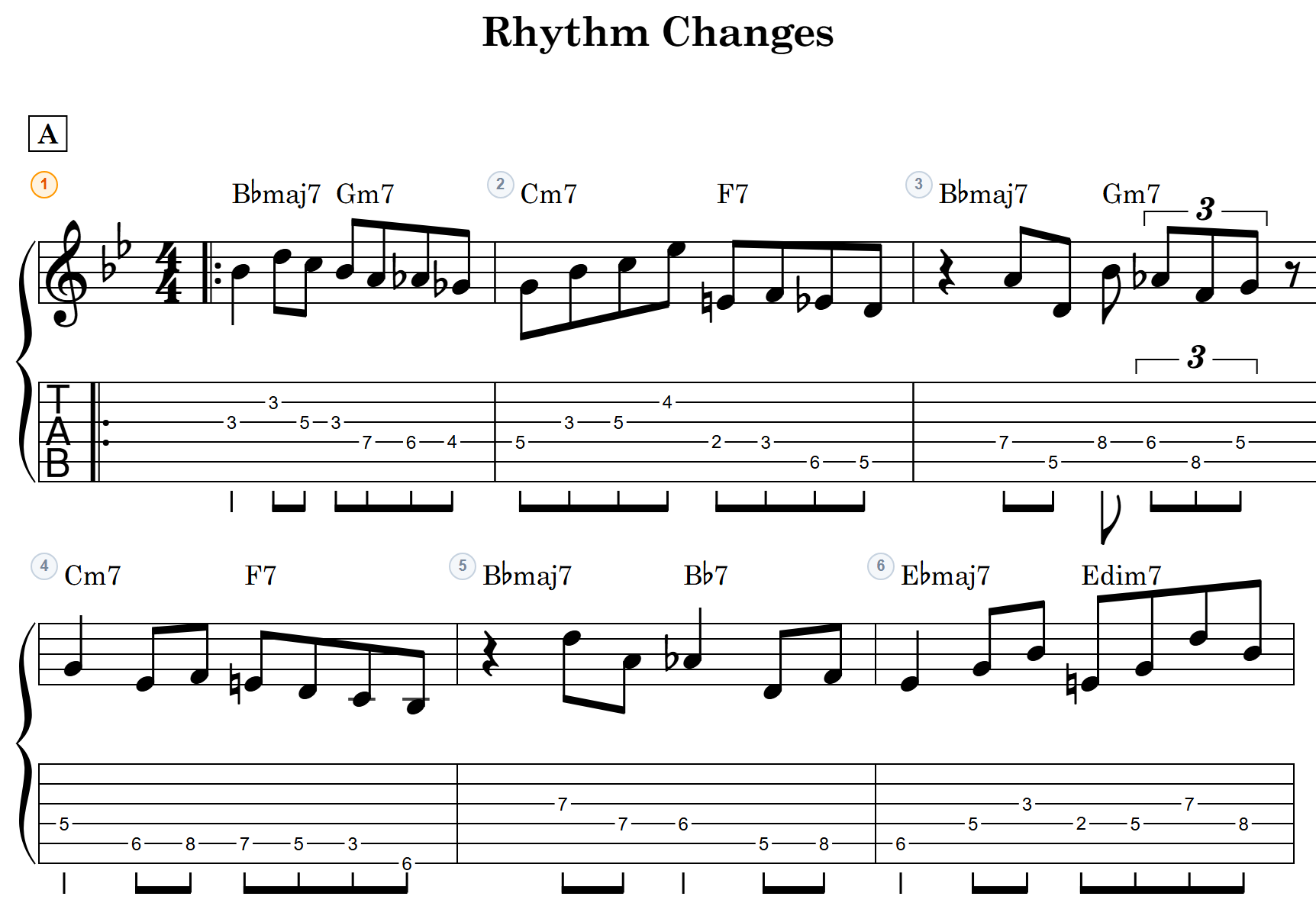
Here are two phrases using the 6th-string root position (around 3fr) introduced in the notes section above. Hit the play button to hear how they sound.
Applying Altered Tensions to Voicings
The altered concept isn’t just for soloing — you can use it in comping too. Adding altered tensions (b9, b13, etc.) to a basic G7 voicing instantly creates that jazz tension.
Adding Altered Tensions to G7
G7
G7(b9)
G7(b13)
The same G7, but adding just one altered note changes the sound dramatically. Hit play to compare.
Natural Tension vs Altered Tension
Take a Drop 2 voicing and change just one note to an altered tension. Same fretboard area, completely different sound.
G7 (natural)
G7 (altered)
The altered G7 on the right sounds unstable and tense compared to the natural G7 on the left. That tension is what makes the resolution to Cmaj7 so much stronger.
Hearing the Difference: II-V-I Natural vs Altered
Same Dm7 → G7 → Cmaj7 progression, but with the G7 voiced two different ways:
Dm7
G7
Cmaj7
Dm7
G7alt
Cmaj7
Notice how the altered version creates a stronger “pull → landing” sensation when resolving to Cmaj7.
How to Build Altered Voicings
The most practical approach: take Drop 2 or shell voicings you already know, and replace 1-2 notes with altered tensions.
Substitution Rules
| Original note | Replace with | Effect |
|---|---|---|
| 9th (natural) | b9 or #9 | Most common altered tension |
| 5th | b13 (#5) | Floating, unstable quality |
| 5th | b5 (#11) | Sharp, angular tension |
Keep the 3rd (major 3rd) and 7th (b7th) — they’re the chord’s skeleton. This mirrors the altered scale itself: root, 3rd, and 7th stay fixed while everything else changes.
Rootless Altered Voicing
When a bassist covers the root, you can build voicings from just 3rd, 7th, and altered tensions:
G7alt
Summary
The altered scale is one of the defining sounds of jazz:
- Improvisation — use it over V7 to intensify the tension-resolution cycle
- Voicings — swap 1-2 notes in a Drop 2 or shell voicing for altered tensions and your comping gains instant jazz sophistication
- Same principle — keep root, 3rd, 7th; alter everything else
Soloing and comping look like separate skills, but through the lens of altered tensions they share the same harmonic logic. Practicing both together deepens your understanding of harmony.
Explore Altered Voicings with notave
notave is a web app that shows practical voicing options the moment you select a chord name.
- Compare voicings with and without altered tensions side by side
- Get voice leading recommendations based on surrounding chords
- Notate your favorites as TAB & standard notation, with playback
Once you understand the theory, the next step is hearing it for real. Use notave to make the altered sound your own.
No install required — free to use right now.